
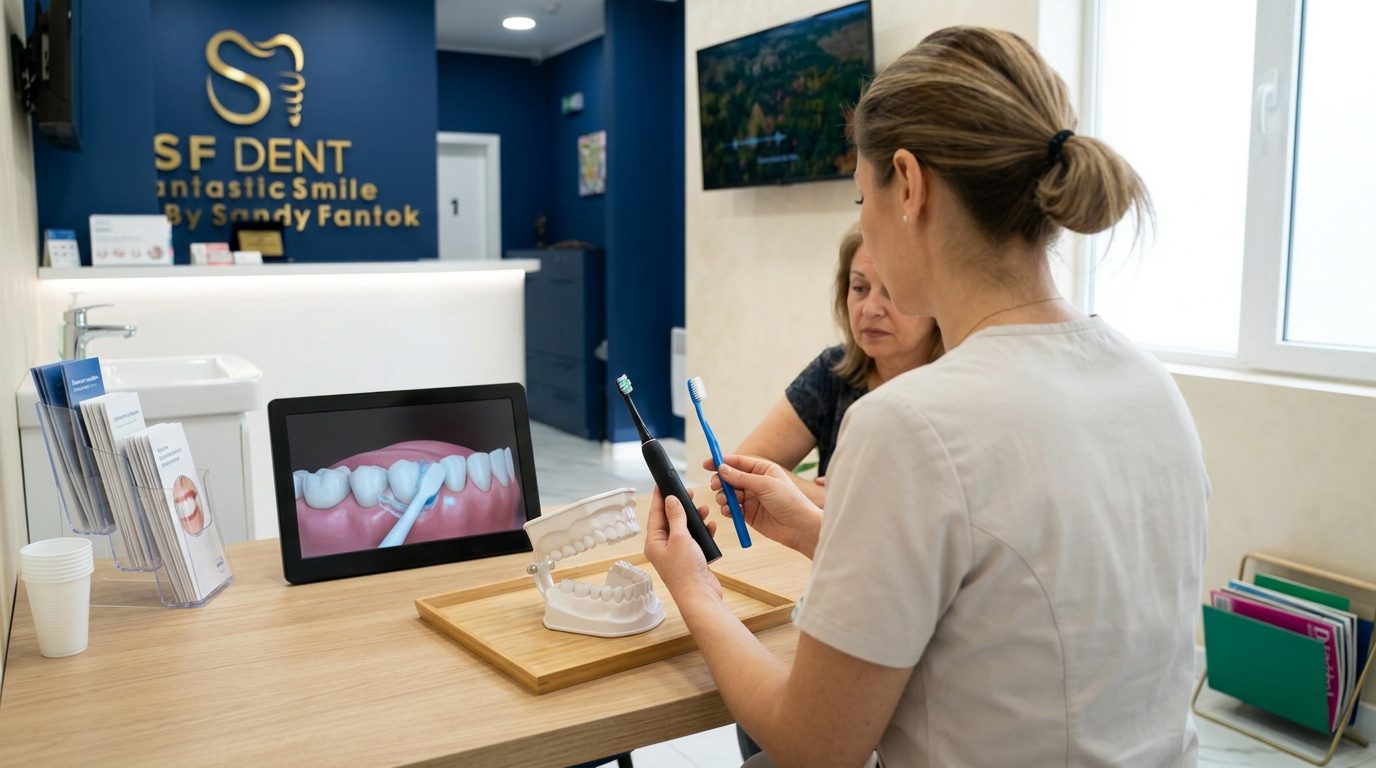
Electric or Regular Toothbrush: A Dentist's Advice
Both types of toothbrushes can clean your teeth well — the difference isn't so much about one brush being "better" or "worse" as it is about brushing technique and the habit of doing it regularly and for long enough. An electric toothbrush simply makes this task easier for most people.
Why an electric toothbrush usually helps more
An electric toothbrush does part of the work for you — the head vibrates or rotates at a constant speed while you just move it slowly across your teeth. This is helpful for people who:
- brush too hard and, over time, irritate their gums or wear down tooth enamel,
- are in a hurry and brush for under a minute,
- have limited wrist mobility (for example, due to arthritis),
- wear braces or have implant structures, where thorough cleaning is more difficult.
With a regular toothbrush, the result depends entirely on technique — the angle of the brush, the pressure, the time, and the order of movements. With an electric toothbrush, much of this is automatically evened out.
What is an ultrasonic toothbrush
An ultrasonic toothbrush is a separate category of electric toothbrushes. While standard electric models work through rotation or vibration in a range you feel as a slight buzz, ultrasonic ones generate much higher-frequency vibrations — so fast that they aren't felt as vibration but rather as a light "buzzing" touch. It's claimed that these vibrations break down some plaque even slightly beyond direct contact with the bristles, but the result still depends on whether you methodically cover all tooth surfaces.
Ultrasonic toothbrushes usually cost more than classic electric models. If you're considering such a purchase, it doesn't have to be your first choice — a good classic electric toothbrush with a timer and pressure sensor does the job for most people.
When a regular toothbrush is completely sufficient
If you brush your teeth twice daily for two minutes, with the correct angle to the gum line and without excessive pressure, a regular toothbrush with soft to medium bristles works excellently. You don't need to change your habit if it's already working well and your dentist doesn't find plaque problems or gum inflammation at checkups.
A regular toothbrush is also more practical for travel, cheaper to replace, and doesn't depend on battery charging.
Children's electric toothbrush — is it worth it
A children's electric toothbrush can make brushing more fun and help a child who struggles to stay motivated to brush long enough — many models have a built-in timer or tune for the two minutes. The head is smaller, and the vibration is weaker compared to adult brushes.
What matters most for children isn't so much the type of toothbrush as supervision: up to around age 7–8, most children still don't have enough fine motor skills to brush well on their own, regardless of whether the brush is electric or regular. A parent should check or finish brushing, especially the back molars.
How to choose between an electric and a regular toothbrush
A few practical questions to ask yourself:
- Do you brush regularly for at least two minutes, twice a day? If not, an electric toothbrush with a timer can help you build the habit.
- Do you have sensitive gums or have you brushed too hard in the past? An electric toothbrush with a pressure sensor reduces the risk of injury.
- Do you wear braces or have an implant? An electric toothbrush often reaches hard-to-access areas more easily, but your dentist may also recommend specific interdental brushes or floss.
- Is your budget limited? A regular toothbrush with good brushing technique remains a perfectly valid choice.
Regardless of the type of toothbrush, fluoride toothpaste and dental floss or interdental brushes remain just as important for overall hygiene.
When to see a dentist
Changing your toothbrush type doesn't solve problems like bleeding gums while brushing, bad breath that won't go away, a loose tooth, or pain when biting. These symptoms require an examination to determine the cause — it could be gingivitis, early periodontitis, tooth decay, or something else that needs treatment, not just a better toothbrush.
If you're not sure which toothbrush suits your case — your specific type of teeth, the condition of your gums, or a child with particular needs — you can ask at your next checkup. The SF Dent team, with Dr. Sandy Festok and Dr. Mina Mihalkov, can also show you the correct brushing technique during a visit to the clinic at 22 Elemag Street, Izgrev, Sofia.
For questions or to book an appointment, you can call or message on WhatsApp at +359 87 666 2785, during business hours Monday–Friday 10:00–19:00, and on Saturdays and Sundays by prior arrangement.
Frequently asked questions
Does an electric toothbrush clean better than a regular one?
With correct brushing technique, both can clean teeth well. An electric toothbrush makes the process easier and is more convenient for people who brush too hard, too briefly, or have limited hand mobility.
What's the difference between an electric and an ultrasonic toothbrush?
A classic electric toothbrush works by rotating or vibrating the head, while an ultrasonic one generates much higher-frequency vibrations that act slightly beyond the area of direct contact with the bristles. Both types are suitable for daily use, but ultrasonic models are usually more expensive.
From what age can a child use an electric toothbrush?
Most manufacturers offer children's electric toothbrushes from around age 3, with a smaller head and weaker vibration. It's important that brushing is done or supervised by an adult until the child masters the technique.
How often should the electric toothbrush head be replaced?
The head should be replaced when the bristles become bent or worn, typically every two to three months, similar to a regular toothbrush.
Is an electric toothbrush suitable for bleeding gums?
The soft heads of electric toothbrushes are often well tolerated by sensitive gums, but bleeding while brushing is a sign that you should see a dentist rather than simply switching toothbrushes.
