
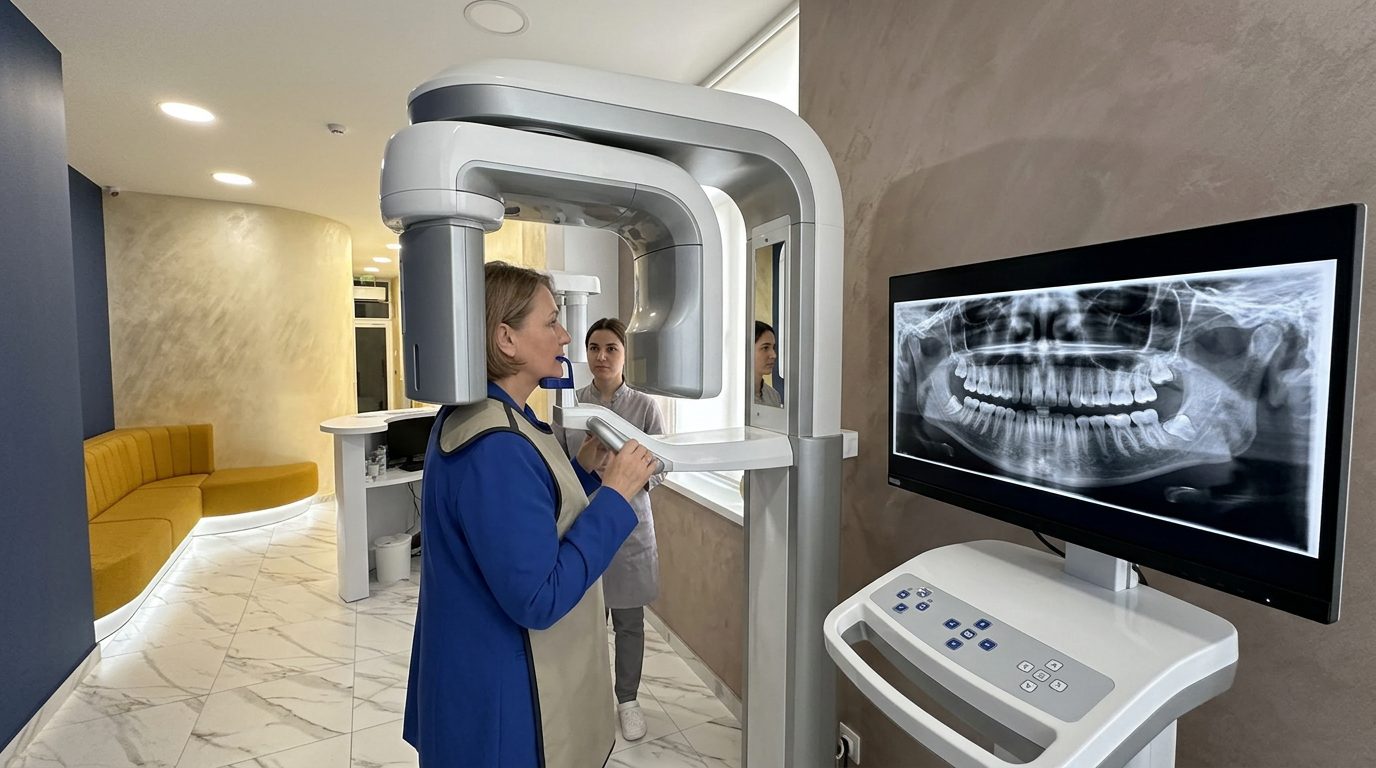
Panoramic Dental X-ray: When It's Needed and What It Shows
A machine slowly rotates around the head for about 15-20 seconds, and the whole jaw appears on the screen - upper and lower teeth, roots, bones, sinuses, and the joints that move the lower jaw. This is the panoramic X-ray, also known as an orthopantomogram or OPG, and it's the most commonly taken dental X-ray in dental practice.
What exactly does the panoramic X-ray show
One image shows the entire dental-jaw condition at once: the number and position of teeth, including unerupted or impacted wisdom teeth, the shape and length of the roots, the bone level around the teeth, old fillings and crowns, as well as any cysts, granulomas, or other changes in the bone. It also shows the proximity of the upper molars to the maxillary sinuses, which is important when planning interventions in that area.
The image is two-dimensional, so structures overlap one another - somewhat like a shadow. This makes it great for general orientation, but not precise enough when something needs to be seen in depth, for example the exact distance between a tooth root and a nerve canal.
When the dentist recommends a panoramic X-ray
The most common reasons are:
- Before wisdom tooth extraction - to see their position relative to neighboring teeth and the lower jaw nerve.
- When planning orthodontic treatment - to assess the position of all teeth, including unerupted ones.
- Before implant placement - as a first, general check of the bone, before a possible more detailed 3D scan.
- In children - to track how permanent teeth are developing under the baby teeth and whether any teeth are missing or unusually positioned.
- When inflammation, a cyst, or another bone change is suspected that isn't visible to the naked eye.
- Before fitting a partial or full denture, to assess the condition of the remaining teeth and bone.
Not every check-up requires a panoramic X-ray - many problems are identified with a simple examination or with a single, targeted X-ray of just one tooth.
Difference between types of dental X-rays
Several types of X-rays are used in dental practice, each with its own purpose:
- Targeted (periapical) X-ray - shows only one or two teeth in detail, including the entire root. Used, for example, in root canal treatment.
- Bitewing X-ray - shows the crowns of upper and lower teeth at the same time, useful for detecting cavities between teeth.
- Panoramic X-ray - overall view of the entire jaw, described above.
- 3D scan (CBCT, cone beam computed tomography) - provides a volumetric image of the bone and teeth, viewed in separate slices in all directions.
The 3D scan is the next step when the panoramic or targeted X-ray doesn't provide enough information - for example, when planning an implant near a nerve or sinus, with complex root canals with unusual anatomy, or when diagnosing deep cysts and root fractures.
How much does a 3D dental scan cost
The price of a 3D scan depends on the scope of the examination - whether only one area of the jaw is scanned or the entire jaw, and on the machine used. For this reason, we don't state a specific price here - the exact figures are in the clinic's price list, and if you have questions, you can simply call or message on WhatsApp to get information for your specific case.
Radiation and safety
The panoramic X-ray uses a low dose of radiation compared to many other X-ray examinations in medicine. The procedure itself is quick and painless - the patient stands still in front of the machine, bites down on a light positioning plate, and waits a few seconds while the machine's arm rotates around the head.
If pregnant or suspecting pregnancy, it's a good idea to inform the team in advance, so they can assess whether and when to take the X-ray.
When to see a dentist rather than just get an X-ray
The X-ray itself doesn't treat anything - it's a tool that helps the dentist make a decision. If you have pain, swelling of the gum or face, bleeding that won't stop, or a feeling of a loose tooth, the right step is a dental check-up, not searching for an X-ray office on your own. At the check-up, the dentist will assess whether an X-ray is needed at all and which type.
In children, regular check-ups with a possible panoramic X-ray help catch early signs of a permanent tooth growing crooked or a missing tooth bud - things that aren't visible with a simple examination.
If you need a panoramic or 3D dental X-ray, or simply want to find out what's suitable for your case, you can call or message on WhatsApp at +359 87 666 2785 to arrange an appointment.
Frequently asked questions
What is a panoramic dental X-ray?
A panoramic X-ray (orthopantomogram) is a single overall X-ray image of both jaws, all teeth, the sinuses, and the lower jaw joints, taken with a machine that rotates around the head for about 15-20 seconds.
When is a panoramic X-ray needed?
It's taken before wisdom tooth extraction, when planning orthodontic treatment or implants, when a cyst or bone infection is suspected, and in children to track the development of permanent teeth.
How does a panoramic X-ray differ from a 3D scan?
The panoramic X-ray is a flat, two-dimensional image that gives an overall picture, while the 3D scan (CBCT) shows the bone and teeth in volume, as separate slices, with much higher precision for implants and complex root canals.
Is it painful to get a panoramic dental X-ray?
No, the procedure is painless - the patient stands still while the machine moves around the head, and nothing is felt during the scan itself.
How much does a 3D dental scan cost?
The price depends on the specific case and the scope of the examination, so we don't state an exact amount here - current prices are in the clinic's price list, and you can call for assistance.
How often can dental X-rays be taken?
There's no fixed rule for all patients - the dentist decides when a new X-ray is needed based on the treatment and previous examinations, to avoid unnecessary radiation exposure.
