
Dental Granuloma and Cyst: What They Are and How They're Treated
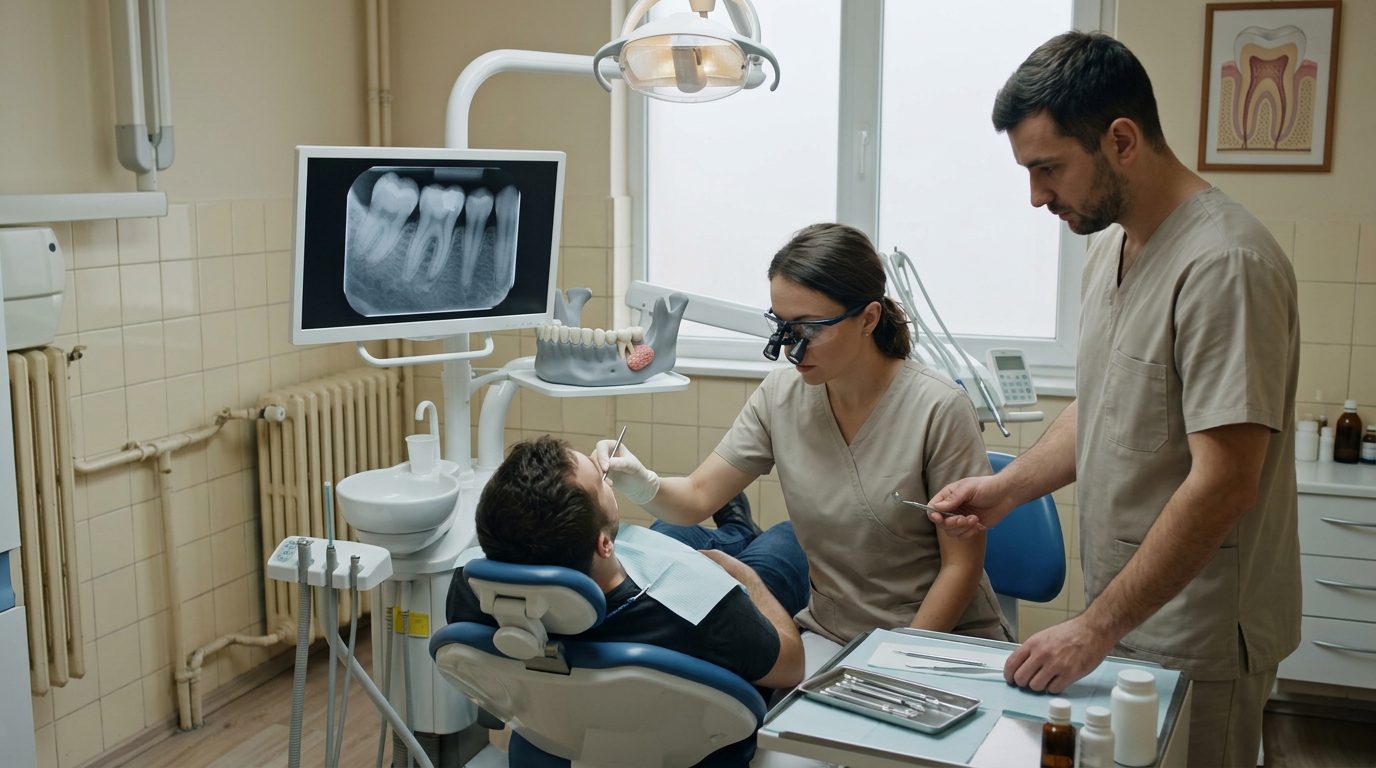
Most patients find out they have a dental granuloma or cyst by accident — on a routine X-ray taken for a completely different reason. The tooth doesn't hurt, the gum looks normal, but the image shows a dark spot around the tip of the root. This is a sign that chronic inflammation is running inside the bone, which the body is currently containing.
What exactly is a granuloma
A dental granuloma is a small focus of chronic inflammation that forms around the tip of the root, most often after the tooth's pulp (nerve) has died — from untreated decay, an old filled tooth with a missed infection, or trauma. Bacteria from the root canal irritate the surrounding bone, and the body responds by building granulation tissue — an attempt to contain the inflammation in one place.
In most cases, the granuloma causes no sensations at all. The tooth may have been treated with a filling or crown years ago, and the patient has no idea that a process is smoldering underneath it.
What exactly is a cyst
If the inflammation continues long enough, a capsule with an epithelial lining and liquid content may form around it — this is already a radicular (root) cyst. The cyst grows more slowly than acute inflammation, but it persistently pushes out and destroys the bone around it, because the internal pressure gradually increases its volume.
In practice, the difference between a granuloma and a cyst can rarely be judged by sight alone or even with a simple X-ray — more precise imaging diagnostics are needed, and sometimes the exact answer only comes after a histological analysis of the tissue removed during treatment.
Symptoms to watch for
Both the granuloma and the cyst can go unnoticed for years. But there are signs worth paying attention to:
- mild sensitivity when biting on a specific tooth, which comes and goes;
- darkening of the tooth compared to the neighboring ones;
- swelling of the gum or face in the area of the affected tooth;
- a small bump on the gum, from which fluid sometimes discharges (a fistula);
- sudden sharp pain — this usually means a flare-up of the chronic process.
None of these symptoms is a definite sign specifically of a granuloma or cyst — they can also indicate other problems. That's why the diagnosis is made after an examination and X-ray, not by description of the sensations.
Why treatment is needed even without pain
Unresolved chronic inflammation does not disappear on its own. Over time, the cyst can grow large enough to affect the roots of neighboring teeth, thin the bone in that area, or — in rare cases in the upper jaw — approach the sinuses. The earlier the problem is caught, the more conservative the treatment options.
How a dental granuloma and cyst are treated
The approach depends on the size of the lesion, the condition of the tooth, and whether it has already had root canal treatment.
Endodontic treatment or root canal retreatment. If the tooth can still be saved, the first step is usually to clean and refill the canals to remove the source of the infection. In many cases, small granulomas and early cysts resolve on their own once the canal has been properly treated — the body gradually rebuilds the bone.
Apical resection (apicoectomy). If classic root canal treatment isn't enough — for example, if the canal is hard to access or has already been treated unsuccessfully — a minor surgical procedure is used, in which the tip of the root is removed together with the inflamed tissue, and the canal is sealed from below.
Cystectomy. For larger cysts, the lesion is surgically removed entirely, and the tissue is usually sent for histological examination to confirm the diagnosis.
Extraction. When the tooth is severely damaged, the roots are cracked, or the structure cannot withstand treatment, extracting the tooth may be the wiser choice to stop the infection from spreading.
Antibiotics are used only in cases of acute flare-up with swelling or general symptoms, and only at the discretion of a dentist or doctor — they suppress the acute infection but do not replace the actual treatment of the tooth.
When to get checked
Don't wait for pain to check an old treated tooth. If you feel prolonged sensitivity when biting, notice a tooth darkening, spot swelling of the gum, or have a fistula with discharge, you should book an appointment as soon as possible. The same applies if you haven't had an X-ray check of teeth with fillings or crowns from years ago — a granuloma or cyst may be quietly developing right there.
If you suspect a dental granuloma or cyst, an examination with an X-ray is the only way to clarify what exactly is happening under the gum and what the best path forward is. You can call or message on WhatsApp at +359 87 666 2785 to book an appointment at SF Dent — the clinic works Monday to Friday between 10:00 and 19:00, and Saturday and Sunday by prior arrangement.
Frequently asked questions
What is a dental granuloma?
A granuloma is a small focus of chronic inflammation around the tip of a tooth's root, which the body isolates with granulation tissue. It usually appears after the tooth pulp becomes irreversibly damaged or dies, and it can go unnoticed for a long time.
What is the difference between a granuloma and a cyst?
A cyst is the next stage — a capsule with fluid content forms around the inflammatory focus, growing more slowly but more persistently destroying the bone. In practice, telling the two apart often requires an X-ray or 3D imaging, and sometimes a histological examination of the removed tissue.
Does a dental granuloma or cyst hurt?
In a quiet state they usually don't hurt and are found by chance on an X-ray. During a flare-up, there may be pain when biting, swelling of the gum or face, or a fistula discharging pus.
Can a granuloma or cyst be treated without extracting the tooth?
Often yes — through endodontic treatment or retreatment of the canals, sometimes combined with an apical resection. The decision depends on the tooth's condition and the size of the lesion and is made after an examination and imaging.
Are antibiotics needed for a dental cyst?
Antibiotics are prescribed only by a dentist or doctor when there are signs of acute inflammation or spreading infection. They do not replace treatment of the actual cause — the tooth with dead pulp.
Does the National Health Insurance Fund cover treatment of a cyst or granuloma?
Some procedures are partially covered by health insurance, but the exact coverage depends on the case. It's best to check directly with the clinic what applies to your specific situation.
